Sunday, April 30, 2017

Ramsey Creek - another possible home in SE Arizona

About an hour and a half east of Patagonia is another lovely eco-niche that appeals to us as a possible long term home.  Ramsey Creek, like Patagonia/Sonoita Creek is another nature preserve in the desert foothills just north of the Mexican border.  In many ways, this canyon feels and looks much like parts of Colorado, though it is happily much warmer in the winter.  :-)

Ramsey Canyon is another one of the very few perennial streams in southern Arizona.  The Nature Conservancy is preserving this fragile and beautiful environment.  Many hummingbirds and sub tropical birds live here

Enormous sycamore trees lined the small creek

One of the original cabins fronted by meadow and Ramsey Creek.  Like so many wetlands that are irreplaceable habitat for birds and wildlife, the creek has been diminished by nearby towns that are drawing down the ground water supply
And right at the beginning of Ramsey Canyon is this 15 unit RV park.  Each RV tucked in it's own private alcove of vegetation.  It's very tempting to us, except that the neighboring town is Sierra Vista, another characterless modern city that looks like it was pooped out of a PlayDoh factory.  Sorry, my prejudices are showing
  
One of the currently vacant RV spaces in this quaint little park


Patagonia - a future home?


As we travel and explore, we're ever mindful of places we might want to settle permanently, or choose for summer or winter homes.  We travelled to Lake Patagonia, just north of Nogales and the border, to have a place in southern Arizona to sail my kayak.  Bodies of water are in short supply in southern Arizona.  We found a lovely lake, perfect size for my sailing kayak, and possibly up to a 15' sailboat, a low mountain terrain, that keeps the summer weather here in the 90's, and still pretty decent weather in winter, good biking, hiking, excellent birding, and a quaint, artsy, small town than strongly appeals to us.  We'll definitely be back.

This is Lake Patagonia, viewed from the peak of Red Mountain.  It is fed by Sonoita Creek, which winds down to the town of Patagonia, and is mostly protected bird sanctuary for the subtropical birds that live and migrate through here.  I'll be posting some of the bird pics in a following blog.  I had a couple of nice sails in the lake in my Bo-nano Boat

Also from the top of Red Mountain (my first "big" hike of the new year - 1600' elevation gain), looking down on the town of Patagonia.  The terrain is a lot like mountainous New Mexico - mesquite, juniper, cat's claw, rolling hills in the 4-5000' elevation range.  Sonoita creek accounts for the green ribbon

Another view of the countryside from Red Mountain - lots of hiking and biking trails, including the major Arizona Trail that the Catholic missionaries travelled.  We boondocked out here, several miles out of Patagonia, and had wild turkeys and a large brown bear for company
A few of the stores on the 2 main commercial streets.  The commercial part of town is 2 streets, about 8 blocks long, if you include the schools.  Next to the Patagonia Market, the brown building is the Velvet Elvis Italian restaraunt, actually a pretty classy place, and it has the 3' x 4" black Velvet Elvis for which it is named

One of several art galleries in town, that also hosts weekend movies.  There's also the Patagonia Opera House and Theatre where music groups come in, and they have community theatre - which Jean and I might both be interested in working with.  It looked like a nice venue, but I failed to get a photo - probably the nicest building in town

The Patagonia Visitors Center is hosted by locals doing 2 hour a week shifts.  We met several fun local residents there.  The former lumber store is now a Pilates studio, which is also in keeping with the town.  There are several health and new agey type retreats in the surrounding burbs and foothills, as well as some nice B&B's
The former railroad depot is now the courthouse and museum.  We met The policeman, and he seemed a nice enough guy.  His office is a mobile home next to the visitor center.


The Gathering Grounds was our favorite place to eat, several vegan and vegetarian options, and they actually knew the difference between the two.  Easy to meet the community here.  I think the feel of this town is somewhere between Guffey, Co, Florence, and a smaller version of Sedona

Amazingly, in a town this size, they have a natural food store with a pretty good selection

The only thing less than ideal here is the RV space.  But the space in the back of this 3 space park could easily be fixed up with bamboo fencing, a new shed, and a cactus garden.  It was very inexpensive, and a 2 block walk to the center of town.  We'll definitely do a month or more here next fall?  spring?

This back space is the one we would take, replace the shed, put in privacy fencing.  Has a nice shade tree.
Finally, a couple of pictures of my hike up Red Mountain, to the Forest lookout station and AT&T antennaes on top
We had thought about being fire watchmen at one point.  Books and nature and no neighbors would have been fine with us, and especially now with the internet.  It was not a bad little setup up there - I peeked in the windows


I've always wanted to climb to an antenae tower.  Jean's brother Kurt may remember a couple of our magical mystery tours attempting to do that in the late 60's - on the Lowry air base air control tower and in the suburbs of Denver following the red blinking lights at night.


Sunday, April 16, 2017

Biosphere 2


A mural of the entire original Biosphere 2
A couple of months ago, Jean and I visited Arcosanti - the low tech, passively heated and cooled "arcology" built by Italian architect Paolo Soleri, in the deserts north of Phoenix.  His goal was low impact, high density sustainable communities that would have a minimum impact on the environment, leaving undisturbed countryside for farming and wilderness right at the dense city's edge.

 This week, we visited a very different experiment in human habitation and sustainability- the extremely high tech Biosphere 2, in the Sonoran desert north of Tucson.  What is it about this state?

Biosphere 2 was a privately funded experiment, built in the early 90's, to explore the possibility of creating a closed self sustaining ecosystem to allow human habitation on other planets.  8 crew members, "biospherians",  farmed and maintained the structure for 2 years, in the first experiment. 

 All manner of difficulties were encountered - wildly fluctuating CO2 levels, oxygen depletion, species die offs and population explosions (cockroaches, of course).  They did manage to survive in the closed environment for 2 years - though at one point injecting additional oxygen for the safety of crew members.  

A second closed ecosystem experiment was later attempted, amidst changed ownership (Steve Bannon's investment company!), which lasted for about 8 months and ended with lawsuits and a good deal of ill will.  The property was vacant for a number of years, and then was purchased and run as a scientific ecological experiment by Columbia University from 95-2005.  It became the property of Arizona State University in 2007, and hosts ecological research as well as being a training facility for some of their programs.  The dome is no longer a closed system, but does allow certain sections to be closed off for experimentation with oxygen and CO2 levels, and such.


The large glass structure contained about 8 different ecosystems, from desert, to ocean to tropical rainforest.  You feel the difference in heat and humidity in each environment.  The white tower section in the middle contained the residences and labs.  The white structures behind that are now hosting experiments on the water cycle - ground water, plant use, evaporation and transpiration, rainfall.  The round dome you partly see on the right is one of 2 "lungs" that allowed for air expansion and contraction as the air heated and cooled when this was a closed environment.

A view from the deck overlooking the rainforest, in the large greenhouse.  The plants were selected to top out at 90 feet, as the dome tops out at just over 100'.  These are the original plantings from the 90's

Looking down over the ocean environment.  It is currently being transformed to emulate the nearby Sea of Cortez, between Baja and mainland Mexico.  On the level we were standing were a coastal fog desert habitat and a savannah ecosystem.  The lush bushes you see just past the ocean on the same level are a mangrove forest

The view out through the foggy glass is the rolling plains, canyons and foothills of the Sonoran desert, or Mars, if such a thing ever happens.

Original kitchen with all the best the 90's had to offer

A model of a possible Martian colony

A "Lunar Garden" module.  Hydroponics I presume.  There was also an "aquaponics" experiment being run by a local highschool - a fish farming tank that drained through several layers of vegetable garden, fertilizing and watering them, and filtering the water, which then pumped back up to the tanks cleaned and oxygenated.  

This is one of three angled tray slopes that have been filled with 6 feet of soil, loaded with sensors in the soil and in the closed atmosphere.  Apparently scientists have never had a good understanding of the actual mathematics behind the earths water system - ground water, amounts used and transpired by plants, effects on the atmosphere, rainfall, etc.  These large trays in 3 domes will be planted with different types of landscapes and all of the variables will be measured and studied - something we can't do in an open environment like the Earth.  This sort of information feeds into the climate models scientists use to understand our environmental challenges

Looking at outside of one of the two "lungs" that stabilized the atmospheric pressure as air heated and cooled, expanded and contracted, in the original closed system of the biospheres.  
Standing inside one of the the now unused lungs.  The stainless convex roof you see above would rise and fall by up to 50 feet as the days heated and nights cooled.  Otherwise the glass structures would have exploded or imploded. The black around the edges is a large rubberized membrane that allowed the expansion and contraction.  This interior lung moved within the glass sphere we're looking at in the picture above.

There were acres and miles of piping, refrigeration, heating, water recirculating in the basements beneath the structure.  It also had its own diesel, natural gas, and solar generating stations, though it is cheaper to be grid tied these days.  You'd definitely need some pipefitting and hvac skills to keep a place like this going

And finally a picture of me embracing a wonderful chunk of Arizona malachite.  Behind is the very nice southwestern housing for ASU students and visiting scientists, interns, etc.

Friday, April 14, 2017

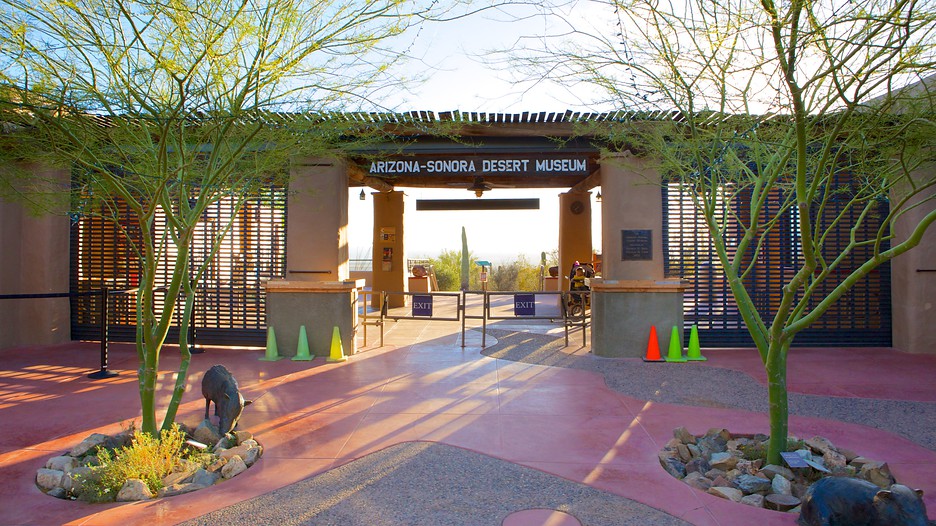
Arizona - Sonora Desert Museum


Tucson has a lot of attractions, and a beautiful setting, but this exhibit in the heart of the saguaro desert is the one that might bring us back here for a season or two.  Museum memberships are not expensive, and would be the way to go here.  There is no way to see this place in a single day, and it changes with the seasons as well.
The desert gardens change with the seasons.  This was early April.  The yellow blooming tree is a Blue Mountain Palo Verde.  I hadn't realized there were different species before this, and was wondering why many palo verde (the Foothills species) weren't booming.  Organ pipes are in the left rear.  I don't recall the name of the large barrels - past their bloom.

This beauty is a Mexican Fox.  They had a virtual zoo of desert creatures, all in natural (if too small) habitat


Eastern Collared Lizard  (eastern?  compared to what?)

This is a Black Bellied Whistling Duck - just sitting there, not whistling...
You can hear him whistling here.  Sounds more like a song bird than a duck, don't you think?
https://www.allaboutbirds.org/guide/Black-bellied_Whistling-Duck/sounds

This mama Bighorn Sheep had this baby just a week ago.  Doesn't she look proud?
They also had a hummingbird aviary that was delightful - this is a Broadbilled Hummingbird
Many of the babies are whitish - I don't know what species this cutie is

Black Headed Grossbeak - beautiful, even if his beak is a bit on the gross side

Mourning Doves.  They are so ever present, everywhere, that I never bother to photograph them.  But I noticed the lovely soft blue on her eyes and beak as she walked past my feet

You need a faster camera, and a better photographer than me to catch a river otter in action - and they are almost always in action!  I stole this photo off the web, but it is one of their otters.  The one we were watching would dive to the bottom, pick up a small flat rock, put it on top of his head, and then swim up, on the surface, dive, twist, tall while trying to keep the rock on the top of his head.  When he would lose it, he'd get another and try again.  If reincarnation is real, let me come back as a river otter!


Saturday, April 8, 2017

Mission San Xavier del Bac


We toured this lovely Spanish mission on the Tohono O'odham Indian reservation just south west of Tucson.  It's a working church that serves the native community there.  The mission was started in the late 1600's, probably under a wood shade ramada, and the present church completed by the late 1700s.  The baroque Spanish/Indian architecture and statuary are so different from European cathedrals.


At times, the mission was deserted, and was used as a camping space or military bivouac, so the entire interior was blackened with soot.  Below, an artist does meticulous restoration work using authentic pigments.

A couple of the wall panels and a close up of one of the angels
A Statue of San Xavier laid to rest below Christ

The Virgin Mary in wedding dress

Angel detail on a pillar - this level of ornamentation was everywhere